
Anubis is the jackal-headed god who prepared the dead for burial and weighed their hearts at judgement. He is one of the oldest gods in the Egyptian pantheon, older than Osiris, and his image is among the most recognisable objects to come out of the ancient world.

What Is Anubis the God Of?
Four connected jobs, all of them about the passage from death to the afterlife:
- Embalming and mummification — he invented the process, on the body of Osiris.
- Protecting the dead and their tombs — guarding both the body and the burial from disturbance.
- Guiding souls to the hall of judgement.
- Weighing the heart against the feather of truth, and operating the scales honestly.
He is not a god of death in the sense of causing it, and he is not an evil figure. His role is closer to that of an undertaker, a guide and an impartial official combined.
Is Anubis a Jackal or a Dog?
This is a better question than it looks, and the honest answer is that nobody is certain.
The convention is "jackal", and it comes from early Egyptologists identifying the animal as the golden jackal that scavenged around desert cemeteries. The logic was sound: the animal that dug at shallow graves became the god who protected them.
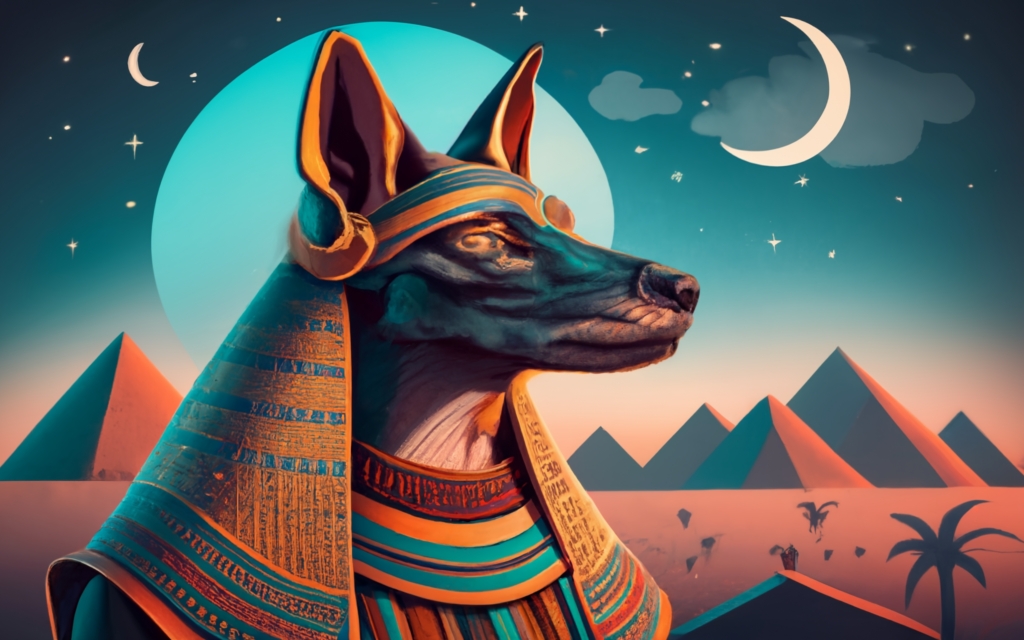
Two problems have since emerged. First, the Anubis animal does not look much like a real jackal. It has a longer, straighter muzzle, tall square-tipped ears and a heavy club-shaped tail, and it is almost always painted solid black — which no jackal is. Many Egyptologists now describe it as a canid, an idealised composite of jackal, wild dog and possibly wolf rather than a portrait of one species.
Second, the animal itself was reclassified. Genetic work published in 2015 established that the African "golden jackal" is not a jackal at all but a distinct species of wolf, now called the African golden wolf (Canis lupaster). So even the traditional identification points at an animal that has since changed its name.
"Jackal-headed" remains the standard description and is what you will see on every museum label. Just know it is a convention rather than a zoological fact.
Why Is Anubis Black?
Not because black meant death. In Egypt black was the colour of the fertile silt the Nile flood left behind — the country's own name for itself, Kemet, means "the black land". Black therefore meant fertility, regeneration and new life.
There is a second layer: black is also the colour of a body after embalming with resins and bitumen. So the colour points at both the process Anubis presided over and the rebirth it was meant to secure. Colour was consistently semantic in Egyptian art, as our guide to how colour carried meaning in Egyptian art sets out.
The Weighing of the Heart
The most reproduced scene in Egyptian funerary art, and Anubis is at the centre of it. The dead person's heart sits on one pan of a balance; on the other sits the feather of Maat, truth. Anubis adjusts the scales and reads the plumb line.
Thoth records the result. Watching from beneath is Ammit — part crocodile, part lion, part hippopotamus — who eats any heart heavier than the feather. Being eaten meant not damnation but annihilation: the person simply ceased to exist, which Egyptians regarded as considerably worse.
The point about Anubis in this scene is his neutrality. He is not prosecuting or defending. He operates the mechanism accurately, and that is exactly why the dead wanted him there.
Anubis and the Invention of Mummification
When Set murdered Osiris and scattered his body, Isis gathered the pieces and Anubis wrapped them — producing the first mummy. That myth made him the patron of embalmers, and it shaped a real professional practice.
The priest performing an embalming wore a jackal mask, becoming Anubis for the duration of the work. Surviving examples of these masks exist, and they are startling objects: the ritual was not symbolic distance from the god but temporary identity with him.
Anubis Before Osiris
Worth knowing because it explains his slightly awkward position in the mythology. Anubis was Egypt's principal god of the dead in the Old Kingdom, and the Pyramid Texts — the oldest religious writing in the world — are full of him.
When the cult of Osiris rose during the Middle Kingdom, Osiris took over as ruler of the underworld and Anubis was, in effect, reassigned. Rather than being displaced he was rewritten as Osiris's son and given the practical work: embalming, guarding, guiding, weighing. It is one of the clearest cases in Egyptian religion of an older god being absorbed rather than discarded. The full cast is in our list of the gods of Egypt.
The Anubis Symbol and How to Recognise Him
Anubis appears in two forms, and both are easy to spot once you know them:
- As a man with a canid head, black, usually holding a was sceptre and an ankh like other gods.
- As a full recumbent animal, lying flat with front paws extended, often on top of a shrine or chest. The Tutankhamun shrine figure is the famous example.
Associated symbols include the imiut fetish — a stuffed headless animal skin hung from a pole in a pot, an odd object that is specifically his — along with the embalming scales, the flail, and the mummy itself.
To distinguish him from other canine gods: Wepwawet ("opener of the ways") is usually grey or white and stands upright as a war and processional god; Duamutef, one of the four sons of Horus, has a jackal head on a canopic jar and guarded the stomach.
Anubis Tattoos and What They Mean
Anubis is one of the most-tattooed Egyptian figures, and the meaning people usually intend is protection, guardianship, and a considered relationship with mortality — often chosen after a death.
That is a faithful reading. Anubis protects the dead and treats them fairly; he is not a figure of menace, whatever modern horror imagery has done with him. If you want the design to be accurate, note the details that mass-market versions get wrong: the ears should be tall and square-tipped rather than pointed like a German shepherd's, the muzzle long and straight, the tail heavy and club-shaped, and the whole animal solid black.
Work from a photograph of the Tutankhamun shrine figure or a tomb painting rather than a flash sheet.
Anubis Statues and Masks in the Museums

The single most famous object is the Anubis shrine from Tutankhamun's tomb: a recumbent black jackal in gilded wood on a portable chest, found facing the entrance of the treasury as though on watch. It had been placed deliberately, and it was still doing its job when Carter found it.
You can see it, along with Anubis amulets, canopic equipment and embalming-priest masks, in the Cairo collections — see our guides to the Egyptian Museum and to Tutankhamun.
Where to See Anubis in Egypt
- The Egyptian Museum, Cairo — the Tutankhamun shrine figure and the amulets.
- The Valley of the Kings — painted judgement scenes with the colour still intact, and Anubis tending mummies on tomb walls.
- The Temple of Hatshepsut, Luxor — has a chapel dedicated to Anubis with unusually well-preserved paint.
- Abydos and Dendera — fine relief work including funerary scenes.
- Saqqara — the Anubieion, his cult centre, where enormous numbers of mummified dogs were buried as offerings.
The Luxor sites sit together on the west bank and appear on almost every itinerary. Our Nile cruises reach them along with the temples between Luxor and Aswan, a 5-day Cairo and Luxor package covers the museum and the Theban tombs on land, and a day tour works if Cairo is your only stop.
Anubis in Modern Culture
He has had an unusually busy afterlife: films, games, comics and a long-running children's television series have all used him, and almost all of them cast him as sinister or as a villain.
That is a misreading. Nothing in Egyptian religion presents Anubis as malevolent. He was a reassuring presence — the god who made sure the body was properly prepared and the scales were read honestly. The modern menace comes from the jackal's association with graveyards, not from anything the Egyptians believed.
Explore More of Ancient Egypt
Keep reading:
- The Gods of Egypt: the full list
- Egyptian Symbols and What They Mean
- The Ankh: Egypt's key of life
- The Eye of Horus
- Egyptian Protection Symbols
- Ancient Egyptian Artifacts
What is Anubis the god of?
Embalming and mummification, protection of the dead and their tombs, guiding souls to judgement, and weighing the heart against the feather of truth. He is not a god of death itself and was never regarded as evil.
Is Anubis a jackal or a dog?
Conventionally a jackal, but the identification is not secure. The Anubis animal has a longer muzzle, taller ears and a heavier tail than a real jackal, so many Egyptologists treat it as an idealised canid combining jackal, dog and wolf features. Genetic work in 2015 also reclassified the African golden jackal as a wolf species, Canis lupaster.
Why is Anubis black?
Because black meant fertility and regeneration in Egypt, being the colour of the Nile's silt — not death. It also matches the colour of a body treated with embalming resins, tying the god to both the process and the rebirth it was meant to achieve.
What is the symbol of Anubis?
The black recumbent jackal and the jackal-headed man are his main forms. He is also identified by the imiut fetish, the embalming scales, the flail and the mummy. He usually carries a was sceptre and an ankh.
Is Anubis evil?
No. Modern films and games routinely cast him as a villain, but no Egyptian source does. He protected the dead, prepared their bodies with care and operated the scales impartially. He was a reassuring figure, not a threatening one.
What does an Anubis tattoo mean?
Usually protection, guardianship and an accepting relationship with mortality, often chosen after losing someone. That reading matches the Egyptian role closely. For accuracy, the ears should be tall and square-tipped, the muzzle long and straight, and the animal solid black.
Who are Anubis's parents?
It varies by period. Early texts make him a son of Ra. Later tradition makes him the son of Osiris and Nephthys, raised by Isis — a story that folded the older god into the Osiris myth once that cult became dominant.
Where can I see Anubis in Egypt?
The Egyptian Museum in Cairo holds the Tutankhamun shrine figure. Painted judgement scenes survive in the Valley of the Kings, the Temple of Hatshepsut has an Anubis chapel, and Saqqara has the Anubieion, his cult centre, where mummified dogs were buried in enormous numbers.
Stand in Front of the Real Thing
We are an Egyptian company running small-group and private trips to the museums and tombs where Anubis actually appears, with licensed Egyptologist guides who can read the judgement scenes off the wall for you.
Plan a private tour → · Nile cruise itineraries · Cairo and Luxor in three nights
Planning your Egypt trip?
Tell us your dates and what you want to see. Our local team replies within 24 hours with a tailor-made plan and a clear price.
Get your free consultation