
The Temple of Abu Simbel, in the south of Aswan along with Lake Nasser’s reinforcement, is the most notorious in all of Egypt after the Giza Pyramids. constructed by the greatest of the pharaohs, Ramesses II, which made it also known as the Temple of Ramses II or Ramesses II, these huge gemstone-cut tabernacles marked the southern boundary of the Egyptian Empire with Nubia at the peak of its power during the New Kingdom.
They were meant to give the power of Egypt’s monarchs to anyone who laid eyes upon them. The four statues guarding the doorway of the larger of these temples are the biggest statuettes that survive from the ancient Pharaonic time.
Where is the Abu Simbel located?
The Abu Simbel Temples are located at Abu Simbel, a small village of Aswan in Upper Egypt near the boundary with Sudan on the western bank of Lake Nasser.
When was the Abu Simbel built?
The Abu Simbel complex, constructed over the course of 20 years in the 13th Century BC, is one of the most magnificent still standing now. Alongside the grand Great Temple stands a smaller temple that honors Ramses' queen, Nefertari.
Why were the Abu Simbel Temples built?
The Temple of Twins was built to serve as a permanent monument to the King and his Queen Nefertari in commemoration of their victory in the Battle of Kadesh.

The Rediscovery of the Abu Simbel Temples
After being lost to civilization for some time, the Temple of Abu Simbel was rediscovered in 1813 by the Swiss explorer John Luisburghardt. The temple was long forgotten, and desert sand covered everything except the top of the head of a giant statue in front of the entrance.
Since the sand was finally cleared in 1909, these twin temples have become the most famous places in southern Egypt.
Relocation of the Abu Simbel Temples
The twin temples of the Temple of Abu Simbel were threatened by the rising water level of the Nile caused by the construction of the Aswan High Dam. The Temple of Abu Simbel was moved from the waters of the Nile to save the ancient temple.
The Temple of Abu Simbel was dismantled and moved to the desert plateau 64 meters above and 180 meters west of its original location in 1968. The movement of the temple did not go well. It was a big job. This involved cutting the temple into pieces weighing 3 to 20 tonnes and reassembling them exactly as they were in the new location. It took almost five years to finish the relocation.

What are the Abu Simbel Temples look like?
There are two temples. The first is the Great Temple dedicated to Ramses II himself, and the second is the Small Temple dedicated to his wife, Queen Nefertari.
Great Temple
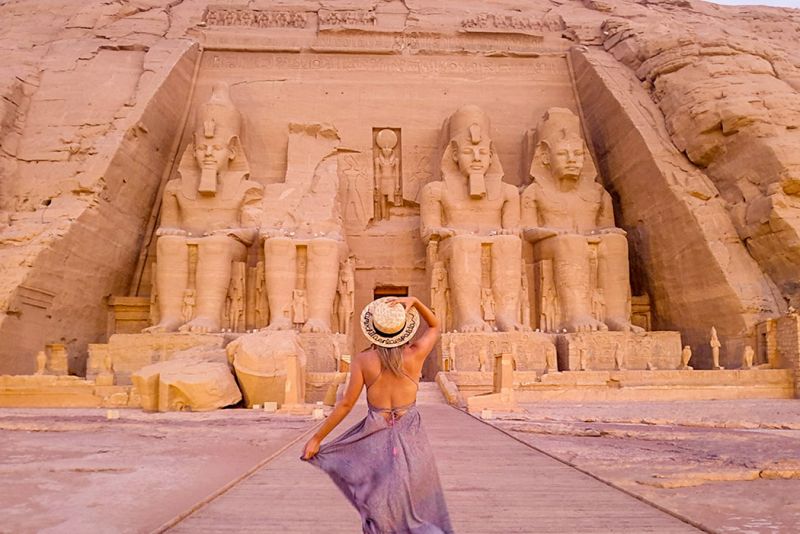
It took about 20 years to build the Temple of Abu Simbel. Also known as the Temple of Ramses II, it was dedicated to Amun, Lahorakti, Ptah, and King Ramses himself. It is generally considered to be the most magnificent and most beautiful temple commissioned during the reign of Ramses II and is one of the finest temples in Egypt. At the entrance to the
Great Temple, there are four giant statues in front, 20 m high, each depicting Ramses II sitting on the throne. The facade of the main hall is decorated with hieroglyphs to commemorate Ramses II's great victory in the Battle of Cades.
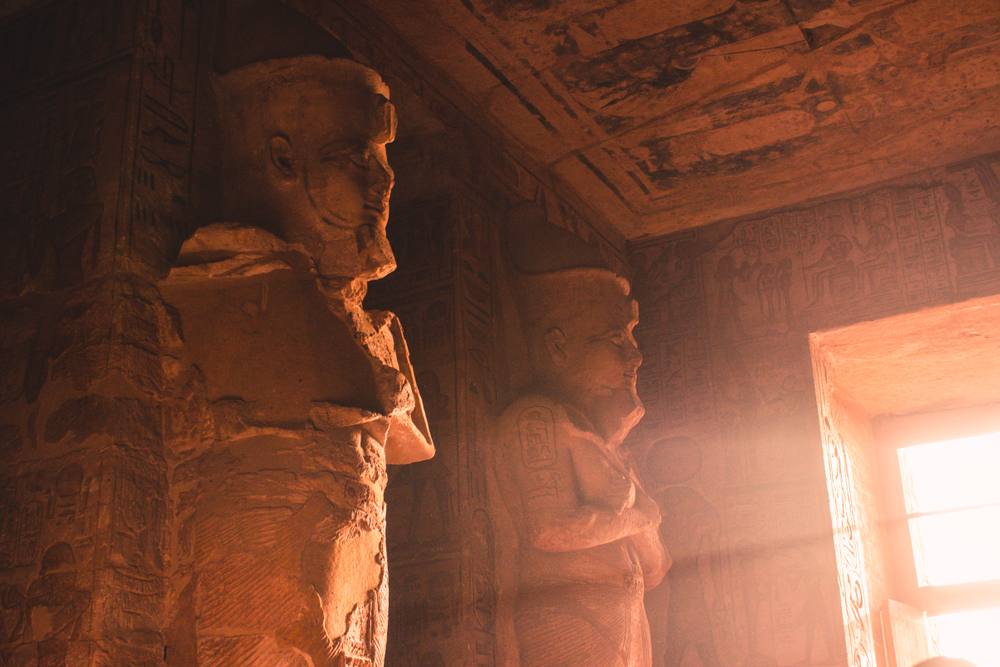
Entering the Great Temple, there are several rooms dedicated to Ramses himself and important members of his family. The last room, the Holy of Holies, is in the dark every day except two days a year. This is not a coincidence, and achieving this result required extensive knowledge of science, mathematics, architecture, and astronomy.
Small Temple
The second temple, the small temple, is dedicated to the goddess Hathor. Much smaller than the first, it was built in honor of Ramses' favorite wife, Nefertari. The queen is the same as the pharaoh. Also known as the Temple of Hathor and the Temple of Nefertari. The rocky façade of the
the temple is adorned with a group of two colossal statues separated by a large gate.

Alignment of the Sun with the Temple of Ramses II, Abu Simbel
The large temple faces the sun, so twice a year the sun shines at the lowest angle, illuminating the statue of Ramses II and the gods to which the temple is dedicated.
Ancient architects arranged the temples so that sunlight could reach the rooms on February 22, the anniversary of his throne, and October 22, his birthday. On these two dates, the sun rises and illuminates three of the four statues in the temple corridor and sanctuary. The first three statues are Pharaoh Ramses II, Ra (the sun god), and Ammon (the king of the gods). Like other pharaohs, Ramses was counted among God because he regarded himself as a god. The fourth statue remains ambiguous as it represents the dark god Ptah. This statue has never seen sunlight for more than 3,200 years.

When is the Abu Simbel Sun Festival?
The Abu Simbel Sun Festival is held on February 22nd and October 22nd each year, and thousands of people gather early in the morning to see the proof of the knowledge and skills that the ancient Egyptians had to perfect the temple.
Visit one of the greatest temples of ancient Egypt by booking one of our tours during your Egypt vacation.
FAQ
What is the significance of the alignment of the sun with the Temple of Ramses II at Abu Simbel?
Twice a year, the sun shines at the lowest angle and illuminates the statue of Ramses II and the gods to which the temple is dedicated. This was arranged by ancient architects so that sunlight could reach the rooms on February 22, the anniversary of his throne, and October 22, his birthday.
What are the two temples in the Abu Simbel complex dedicated to?
The first temple, the Great Temple, is dedicated to Amun, Lahorakti, Ptah, and King Ramses II himself. The second temple, the Small Temple, is dedicated to the goddess Hathor and was built in honor of Ramses’ favorite wife, Nefertari. The queen is also honored in this temple and it is known as the Temple of Hathor and the Temple of Nefertari.
Planning your Egypt trip?
Tell us your dates and what you want to see. Our local team replies within 24 hours with a tailor-made plan and a clear price.
Get your free consultation