
Let's be honest: when most people plan a trip to Egypt, they immediately think of Cairo, the Giza Pyramids, and maybe a quick flight down south to see Luxor. But once you start looking at how to travel between Luxor and Aswan, you run into a major question: should you book a massive, commercial cruise ship, or is it worth paying more for a small, traditional sailboat called a Dahabiya?
For many, the idea of a three-day or six-day Nile cruise sounds relaxing, but there is always a bit of hesitation. Will it feel too touristy? Will you be stuck on a loud, vibrating ship with 150 other people, being rushed from one crowded temple to another? If you choose a standard commercial boat, the answer is often yes. But if you opt for a smaller, slower wind-powered Dahabiya, the entire experience changes.
At Ez Tour Egypt, we believe travel should be about actual connection, not just ticking off monuments from a list. In this guide, we will break down the real differences between these boats, look at what a 6-day itinerary actually feels like, and talk about the ancient ruins that large commercial boats physically cannot visit. We will also cover the daily logistics, the local food, and what you need to know about safety and dress codes in 2026.
Plan Your Egypt Trip with Local Experts
If you want to skip the standard tourist crowds and plan a customized itinerary, take a look at our private tour packages.
The History: Why Slower is Better on the Nile
The word 'Dahabiya' means 'the golden one' in Arabic. Back in the 19th century, these elegant wooden sailboats were the only way for royal families and wealthy travelers to travel along the river. They relied entirely on the wind to slide between Luxor and Aswan, offering a quiet, private journey.
Everything changed around 1870 when the steamboat was introduced to Egypt. Steamboats could cover the distance in half the time, making them the default choice for mass tourism. This shift eventually led to the massive multi-deck cruisers we see today. But while speed made travel more efficient, it took away the peace of the river.
When you choose a 6-day nile river cruise dahabiya, you are deliberately choosing to slow down. Because there is no loud diesel engine running 24/7, the sailing is almost silent. You can actually sit on the open deck, read your book, and watch rural Egyptian life go by. On either side of the river, you see a thin strip of lush green farmland, followed immediately by massive desert sand dunes stretching for miles. You see farmers working their fields, water buffalo cooling off in the shallows, and kids playing along the banks. It is a side of the country that you completely miss from a high-speed vehicle or a crowded bus.
What Large Boats Physically Cannot Do
The physical size of a boat dictates where it can stop. Large commercial cruisers, which typically carry 100 to 150 people, have deep drafts and require large docks. This means they can only stop at the major ports, and they always arrive at the exact same time as dozens of other ships, leading to massive crowds.
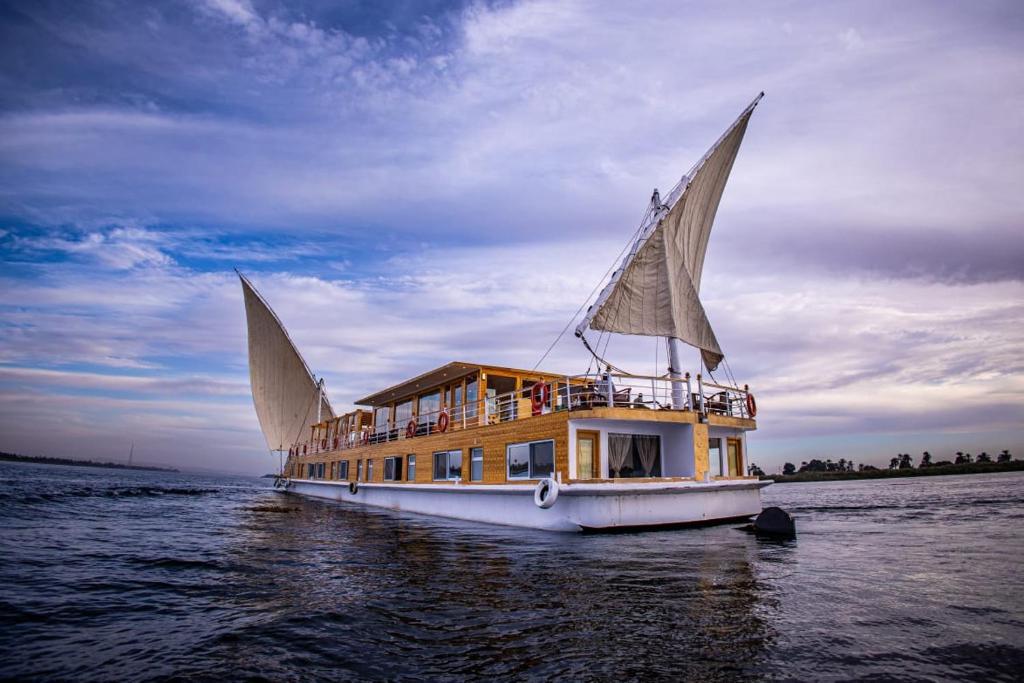
A Dahabiya has a flat bottom and a very shallow draft. This allows the captain to simply pull the boat up to the natural riverbank, tie a rope to a palm tree, and let you step directly onto the shore. Because of this, a Dahabiya gives you exclusive access to incredible historical sites that large ships have to skip entirely:
The Ancient Tombs of El Kab:
Carved high into the desert cliffs, these tombs belong to the nobles of the New Kingdom. Because they are off the beaten path for mass tour buses, you can walk through the painted chambers in absolute silence, studying the detailed hieroglyphs without a single crowd around you.
Gebel el-Silsila:
This is one of the most unique, 'Indiana Jones' style sites in Egypt, and big boats cannot dock here. This ancient sandstone quarry sits where the Nile narrows dramatically between rocky cliffs. It is the exact site where ancient builders cut the massive sandstone blocks used to build Karnak and Luxor temples, floating them down the river thousands of years ago. Walking through the rock-cut shrines and looking at the ancient graffiti left by stone-cutters is an experience you won't forget.
Private Day Trips in Luxor & Aswan
Our private tours are led by licensed Egyptologists who actually know the history. No massive tour buses, no rushing.
The Onboard Experience: Market-to-Table Food
Let's talk about the food, because it is a massive part of any travel experience. On a large cruise ship, feeding 150 people requires large-scale buffet cooking. The food is fine, but it often lacks local flavor and fresh variety.
On a Dahabiya, things are different. Since there are usually only eight to twelve passengers on board, the kitchen operates like a private home. Every time the boat docks near a local town, the chef walks into the local markets to buy fresh fruits, vegetables, spices, and meats directly from local farmers. They bring these ingredients back on board and prepare traditional Egyptian dishes from scratch.
You will eat fresh falafel, rich lentil soups, handmade bread, and slow-cooked vegetable tagines. Everything is incredibly fresh, and the variety changes based on what is in season. It is a level of culinary quality that is simply impossible to replicate on a commercial cruiser.
The rooms themselves feel like floating bedrooms. With large windows that open directly to the river breeze, you don't feel the vibration or smell the diesel fumes of a standard ship. The only way you can tell you are moving is by looking out the window and watching the palms slide past.
A Realistic Look at the Historical Stops
A 6-day itinerary is designed to give you plenty of downtime while still covering the most impressive monuments between Luxor and Aswan. Here is what you will actually see:
The Temple of Khnum in Esna:
Often your first stop, this temple sits in a deep pit several meters below the modern street level of Esna. It is famous for its highly detailed, massive columns and beautifully carved ceiling astronomical charts.
The Temple of Horus in Edfu:
This is one of the best-preserved ancient temples in the world because it lay buried under protective desert sand until 1859. This sand kept it safe from the Romans, who destroyed other temples to eliminate local religions. Because you are on a smaller boat, you can time your visit to avoid the peak hours when large group buses arrive.
Kom Ombo and the Crocodile Museum:
This unique temple has a symmetrical double design, dedicated to both Horus the Elder and the crocodile god, Sobek. The quality of the stone carvings here is incredible—you can still see the fine lines and details on the faces and bodies of the carvings. Right next to the ruins is a museum dedicated entirely to mummified crocodiles that once swam along the banks of Kom Ombo.
Book Your Nile Cruise Cabin
We can help you find and book verified, top-tier cabins on Dahabiyas or luxury cruisers.
Browse Nile Cruise Options
What Should You Wear?
You will see some tourists wearing very casual beach clothing at ancient temples. While local authorities won't stop you, dressing modestly is highly recommended for your own comfort. Wearing loose, breathable clothing that covers your shoulders and knees keeps you cool under the intense sun, reduces sunburn, and prevents unwanted staring. It is also a simple sign of respect for the local culture.
How Tipping Works:
Tipping (known as Baksheesh) is a fundamental part of the local economy. In Egypt, many workers rely on tips to support their families. If you are on a standard tour, you might feel like you are tipping constantly for every small interaction. On a Dahabiya, this is much simpler. Instead of tipping every individual driver or crew member, you simply leave one collective tip in an envelope at the end of the cruise, which is then shared fairly among the entire onboard crew.
Structuring Your Egypt Itinerary in 2026
If you are planning your overall journey, you need to decide how to balance your days. A standard 7 day egypt tour package is the most popular option, usually dedicating three days to cairo sightseeing—including the Giza Pyramids and the new museums—before flying south for a nile cruise.
If you have more time, extending your stay to include a 6-day Dahabiya trip offers a far more relaxed, satisfying rhythm. It gives you the time to actually digest the history you are seeing, rather than rushing from site to site with packed bags. If you want to explore further, you can combine your trip with other regional highlights by looking at egypt and jordan luxury tours, which allow you to see Petra and the Dead Sea before heading to the Nile.
At Ez Tour Egypt, we are committed to making your trip as seamless and authentic as possible. We don't use rigid, cookie-cutter templates. We handle all your logistics, from domestic flights to private, licensed drivers and expert guides, ensuring you can simply relax and enjoy the journey.
Planning your Egypt trip?
Tell us your dates and what you want to see. Our local team replies within 24 hours with a tailor-made plan and a clear price.
Get your free consultation