

The Flight into Egypt: What Scripture Says, and What Tradition Adds
The gospel account runs to five verses. Almost everything else people know about it — the route, the miracles, the years — comes from somewhere else. Here is which is which.
- Licence 547 — Egyptian Ministry of Tourism
- 40 years operating in Egypt
- Written by our Cairo team
What the Flight into Egypt is
The Flight into Egypt is the episode in the Gospel of Matthew in which Joseph is warned in a dream to take Mary and the infant Jesus and escape to Egypt, because Herod intends to kill the child. They stay until Herod dies, then return.
It appears in Matthew 2:13–23 and nowhere else in the New Testament. Mark, Luke and John do not mention it.
How short the account actually is
This is the part that surprises most people. The entire episode occupies about five verses. It records that an angel appeared to Joseph in a dream, that the family left by night, that they remained in Egypt until Herod’s death, and that this fulfilled a prophecy.
It gives no route. No place names inside Egypt. No duration beyond “until the death of Herod”. No description of the journey, no companions, no hardships.
Everything else — the years, the towns, the miracles, the donkey — comes from later tradition, from apocryphal writings, or from art. That does not make it worthless. It makes it a different kind of source, and worth knowing which you are reading.
“Out of Egypt I called my son”
Matthew presents the flight as fulfilling a line from the prophet Hosea. In its original context that line referred to the Exodus — to Israel as a people being brought out of Egypt.
Matthew’s use of it is deliberate. His gospel repeatedly draws parallels between Jesus and Moses: a ruler killing infant boys, a child escaping, a return from Egypt, a lawgiver on a mountain. For a first-century Jewish readership those echoes carried the argument. Recognising the pattern explains why the episode is in Matthew and not in the other gospels — it serves his particular case.
Why Egypt, of all places
Practically, because it worked. Egypt was outside Herod’s jurisdiction but close — a matter of days from Bethlehem. It was a Roman province with settled government, and it already held a very large, long-established Jewish community, particularly in Alexandria, which had produced the Greek translation of the Hebrew scriptures.
A Jewish family arriving from Judea would not have been conspicuous. Egypt had been the standard refuge for people fleeing trouble in Palestine for centuries.
What the apocryphal texts add
The stories most people picture come mainly from later, non-canonical writings — above all the Gospel of Pseudo-Matthew, compiled centuries after the events, and the Arabic and Armenian infancy gospels.
These supply the scenes that entered art and folk memory:
The palm tree that bends down so Mary can reach its dates, and a spring that opens at its root. The dragons and wild beasts that come out and do homage rather than attack. The Egyptian idols that fall and shatter as the family enters a temple. The robbers on the road, one of whom is later identified with the thief crucified beside Jesus.
None of this is in the canonical gospels. It is legend that grew around a five-verse account, and it is the raw material for a thousand years of painting.
What Coptic tradition adds
Egypt’s own church holds a far more detailed account, and it is a living one. Coptic tradition maps a route of roughly three and a half years, entering from Sinai, moving through the Delta, down to the area of Old Cairo, and then south into Middle Egypt.
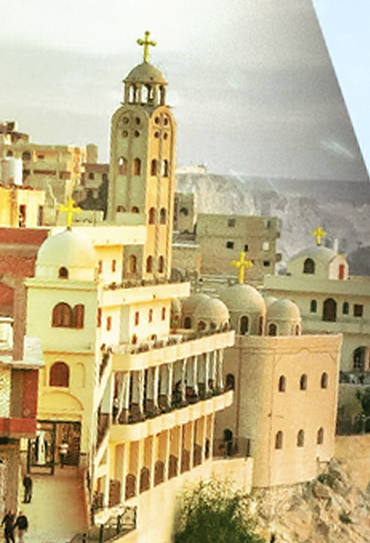
The southernmost point in the tradition is Deir el-Muharraq, near Assiut, where the family is said to have stayed about six months — the longest single stop — before the angel appeared again and told Joseph to return.
Around twenty-five sites along this route are venerated. In 2017 the Egyptian government and the Coptic Church formally developed it as a pilgrimage trail, and the Vatican has recognised a number of the stations. Whether one reads it as history or as devotion, it is a real and continuous tradition with physical places attached.
The Massacre of the Innocents
The flight is triggered by Herod’s order to kill the boys of Bethlehem under the age of two. Matthew reports it in a single verse.
Historians debate it. Herod’s cruelty is very well attested by Josephus, who records him executing his own wife and three of his sons. But Josephus does not mention this particular order, and Bethlehem was a small village — modern estimates put the likely number of boys of that age in the low dozens at most, not the thousands of later legend. In a reign already full of killings, an incident on that scale may simply not have registered with chroniclers.
The honest position is that it is neither corroborated nor implausible.
The Flight into Egypt in art
Few episodes have been painted more often, partly because it offered artists something rare: a landscape, a journey and a family, rather than a throne or a crucifixion.
Giotto put it on the walls of the Scrovegni Chapel. Fra Angelico, Duccio and Gentile da Fabriano all painted it. Caravaggio‘s version places an angel playing a violin between an exhausted Joseph and a sleeping Mary. Later painters, from Poussin to Tissot, kept returning to it.
A related subject, the Rest on the Flight into Egypt, became a genre of its own — the moment of pause under the palm, which comes from the apocryphal material rather than Matthew. If you have seen a painting of the Holy Family resting beside a palm tree, you have seen Pseudo-Matthew, not the New Testament.
The route, as Coptic tradition maps it
The trail runs from Sinai through the Delta, down past Old Cairo and south into Middle Egypt, ending at Deir el-Muharraq. Around twenty-five sites along it are venerated.


Where the Flight into Egypt can actually be visited
The tradition is unusual in having a geography you can walk.
Abu Serga, Old Cairo
The crypt beneath the Church of St Sergius, held to have sheltered the family. In Coptic Cairo, free to enter.
Gabal el-Teir, Minya
A cave church on the cliff above the Nile, traditionally founded in the fourth century.
Deir el-Muharraq, Assiut
The southernmost station, and the longest stay in the tradition.
Deir Dronka, Assiut
Cut into the mountainside, and the site of a very large August pilgrimage.
Matariya, Cairo
The Virgin’s Tree, associated with the family’s rest on the northern part of the route.
The river itself
The stretch between Cairo and Assiut, which the route follows and almost no cruise sails.
We run a five-day Nile cruise along that southern stretch — Beni Suef, Minya and Assiut — calling at the monasteries. Four nights on board, full board, from US$ 625 per person.
Questions about the Flight into Egypt
Where in the Bible is the Flight into Egypt?
Matthew 2:13–23, and only there. It does not appear in Mark, Luke or John. The passage covers the warning dream, the departure by night, the stay in Egypt, Herod’s death and the return to Nazareth.
How long were they in Egypt?
The gospel says only “until the death of Herod” and gives no figure. Coptic tradition puts it at about three and a half years, with roughly six months at Deir el-Muharraq. That number comes from tradition, not scripture.
What route did the Holy Family take?
Matthew gives none. The detailed itinerary — Sinai, the Delta, Old Cairo, then south to Minya and Assiut — is Coptic tradition, developed over centuries and marked by around twenty-five venerated sites. It is a real pilgrimage trail; it is not a route recorded in the New Testament.
Is the palm tree story in the Bible?
No. The bending palm, the spring at its root, the falling idols and the tame wild animals all come from apocryphal infancy gospels, principally Pseudo-Matthew, written well after the canonical gospels. They are the source of most Flight into Egypt imagery in Western art.
Did the Massacre of the Innocents actually happen?
It is recorded only in Matthew and is not corroborated by other sources, including Josephus, who otherwise documents Herod’s violence in detail. Bethlehem was small enough that the number of boys involved would likely have been in the low dozens. Historians are divided; the accurate answer is that it is unverified rather than disproved.
Why did they go to Egypt specifically?
Because it was outside Herod’s authority, only days away, under stable Roman administration, and already home to a large Jewish population. It was the obvious refuge, and had been for centuries.
What does “Out of Egypt I called my son” mean?
It is a line from Hosea that originally referred to the Exodus — to Israel being led out of Egypt. Matthew applies it to Jesus as part of a sustained parallel between Jesus and Moses that runs through his gospel.
Can you follow the Holy Family route today?
Yes. The Egyptian government and the Coptic Church developed it as a formal pilgrimage trail, and the sites are open to visitors of any faith. The northern stations are around Cairo; the southern ones are in Minya and Assiut and see very few foreign visitors.
Stand in the places the tradition names
The southern stations see almost no foreign visitors. Tell us your dates and group size and we will send the cruise dates and the price in writing.