
The Egyptian Ankh in Art and Jewellery
The ankh is unusual among ancient symbols in that it never stopped being worn. Egyptians hung it round their necks in glazed faience five thousand years ago; people buy it in gold today. This page is about the object rather than the idea — where the ankh appears in Egyptian art, what ancient ankh jewellery was actually made of, what a modern ankh necklace or tattoo signifies, and how to tell a decent piece from tourist tat in a Cairo market.
For the symbol's meaning, origin and pronunciation, start with our main guide to the ankh and why it is called the key of life.
What the Ankh Meant to the People Who Wore It
An Egyptian wearing an ankh was not making a style choice. The sign is the hieroglyph for "life," and wearing it was closer to carrying a written wish than to wearing a logo — a request for health, breath and continued existence, addressed to gods who were understood to be listening.
That is why ankhs turn up in graves as often as in houses. The wish did not expire at death; it was most needed then. Our companion piece on what the key of life really represents goes into the theology behind it.

Ankh Amulets in Ancient Egypt
Ankh amulets survive in enormous numbers — they are among the most common small finds from Egyptian sites, which tells you they were ordinary possessions rather than elite objects. Most are between two and eight centimetres tall, pierced at the top of the loop for a cord.
They were worn in life and then wrapped into the mummy bandages, positioned deliberately: over the chest, at the throat, or in the hands. Embalmers followed set schemes for where each amulet went, so an ankh's placement in the wrappings was a decision, not a decoration. The same logic governed the other protective symbols Egyptians wore.
What Ancient Ankh Jewellery Was Made Of
Material carried meaning in Egypt. Colour was not aesthetic; it was semantic.
- Faience — a glazed quartz paste, usually turquoise or blue-green. By far the most common material for ankh amulets, and chosen because that colour meant the Nile, new growth and rebirth. A faience ankh says "life" twice: once in shape, once in colour.
- Gold — the flesh of the gods, and incorruptible. Reserved for royalty and temple goods.
- Carnelian — deep orange-red, associated with blood, vitality and the sun.
- Lapis lazuli — imported from Afghanistan, more valuable than gold at some periods, and linked to the night sky and the hair of the gods.
- Glazed steatite, wood, bronze and glass — everyday materials for everyday people.
How to Spot an Ankh on a Temple Wall
Once you know what to look for, you cannot stop seeing it. Three positions account for almost every ankh in Egyptian relief:
- Held by the loop, hanging from a god's hand. The commonest by far. The fingers go through the loop; the stem hangs down.
- Pressed to the king's nose or lips. The god is giving him the breath of life. This is a sentence written in pictures.
- In a row along a border or frieze, often alternating with the djed pillar and the was sceptre — life, stability, dominion, repeated as a decorative band.
A fourth, rarer form is worth watching for: the ankh with arms, holding a fan or a sceptre, which appears in reliefs from the Amarna period and in some later temples. It is the symbol drawn as a living being. You will find good examples at Luxor Temple, and a full survey of the sign alongside its relatives in our guide to the wider family of signs Egypt used.
The Ankh in Tomb Goods and Funerary Objects
Egyptian craftsmen liked making useful objects in the shape of the sign, so the object itself became a statement. The best-known survives from Tutankhamun's tomb: a mirror case of gilded wood cut in the outline of an ankh, holding a mirror that no longer survives. The pun is deliberate — one theory of the ankh's origin is that it depicts a mirror case in the first place.
Other forms recur: ankh-shaped lamps and censers, ankh handles on ritual vessels, ankhs inlaid into pectoral collars, and ankhs worked into the openwork of gold pendants alongside scarabs and the Eye of Horus. Many of the finest are in the Egyptian Museum in Cairo.
Ankh Necklaces Today
The ankh necklace is the most common form the symbol takes now, and the modern version is a fairly faithful descendant of the ancient one: a pendant pierced through the loop, hung on a chain or cord.
The proportions vary, and they are the quickest way to judge a piece. Ancient ankhs have a loop that is noticeably taller than it is wide, a crossbar roughly level with the top of the stem, and a stem about twice the height of the loop. Mass-produced modern pieces tend to widen the loop into a circle, which flattens the whole shape and is the single clearest tell of a design that was drawn from another modern pendant rather than from an Egyptian original.
What Does an Ankh Necklace Mean?
Worn today, an ankh generally carries one of four meanings, and they are not exclusive:
- Life and vitality — the original sense, still the most common.
- African and Egyptian heritage — particularly in Black American and Pan-African contexts, where the ankh has been a symbol of continuity and origin since the 1960s.
- Coptic Christian faith — the crux ansata, used in Egypt for some seventeen centuries.
- Protection and spiritual practice — in New Age and neo-pagan use, worn much as an amulet was.
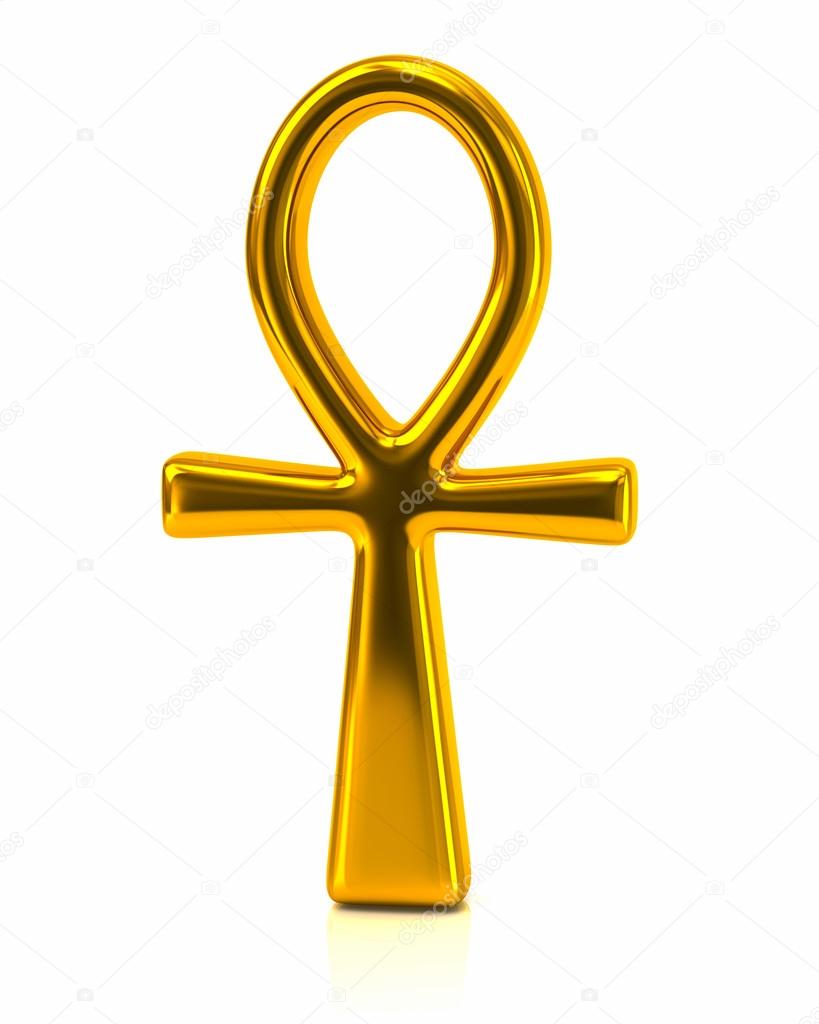
Gold Ankh Pendants and Chains
Gold is the material with the strongest claim to authenticity, because Egyptians regarded it as the substance of divine flesh — a gold ankh was the most emphatic version of the object it was possible to make.
Egypt has a working gold trade with real craftsmen, and 18-karat is the standard local grade. Cairo jewellers will cut an ankh to order, and many will also inlay a cartouche with a name spelled in hieroglyphs. If you want to see what your own name looks like before you commission anything, our free hieroglyphics translator will render it sign by sign.
Ankh Rings, Earrings and Bracelets
Beyond the pendant, the sign adapts easily. Ankh rings usually set the symbol flat across the band or raise it as a signet. Ankh earrings work because the loop provides a natural hanging point, exactly as it did for amulets. Bracelets tend to repeat the sign as a linked motif, echoing the friezes on temple walls where ankhs run in a row.
Ancient parallels exist for all three. Egyptian jewellery was extensive and technically superb — broad collars, armlets, anklets, finger rings — and the ankh appears across the whole range.
The Ankh Cross in Jewellery
Ankh cross pendants sit in an interesting position, because the piece is genuinely both things at once. Coptic Christians adopted the ankh in the third and fourth centuries CE as the crux ansata, keeping its meaning of eternal life, and it has been in continuous Christian use in Egypt ever since.
Coptic workshops in Cairo still make it, often with the loop shaped as a wreath or with a Latin cross worked inside the loop. A piece bought from a Coptic silversmith is a living tradition rather than a revival.
Ankh Tattoos
The ankh is one of the most-tattooed symbols in the world, helped by a shape that works at almost any size and reads clearly in plain black line.
The one detail worth getting right is the proportion described above. A tattooed ankh with a circular loop reads as generic; one with the tall, narrow Egyptian loop reads as the real sign. If you want the accurate outline, look at a photograph of a temple relief rather than at a tattoo flash sheet.
What Does an Ankh Tattoo Mean?
Most people who choose it mean life, survival, or the memory of someone who died — the last being the closest modern equivalent to the ancient funerary use, where the ankh was a wish for continued existence placed with the dead. Others wear it for heritage, for faith, or as a marker of an interest in Egypt. None of these readings is wrong; the symbol has been carrying several meanings at once for five thousand years.
The Ankh and Eye of Horus Tattoo
Pairing the two is a common design, and it is a coherent one. The ankh gives life; the Eye of Horus restores and protects it. Together they cover granting and guarding, which is roughly why the ancient Egyptians also wore them together.
The pitfall is picking the wrong eye. The Eye of Ra looks similar but means something close to the opposite — it is a destructive, punishing force rather than a healing one. We set the two side by side in our guide to how the two eyes differ, which is worth five minutes before anything becomes permanent.
Where to Buy Ankh Jewellery in Egypt
Khan el-Khalili in Islamic Cairo is the obvious place and still the best one — a working bazaar with real goldsmiths behind the tourist frontage. The gold souk section is where the serious workshops are.
Practical points, in the order they will matter:
- Gold is sold by weight at the day's rate, plus a making charge. Ask for the two figures separately; a seller who will not separate them is not selling you gold.
- Look for the hallmark. Egyptian gold is stamped. 18-karat is the usual grade for this kind of work.
- Silver is stamped 925. Unstamped "silver" is usually alloy.
- Cartouche work is made to order and takes a day or two, so ask early in your trip rather than on the last afternoon.
- Haggling is expected on craft pieces, and not on gold sold by weight.
One thing you cannot buy: genuine ancient pieces. Exporting antiquities from Egypt is illegal, and anything offered as a real amulet is either a reproduction or the beginning of a serious legal problem. Buy the modern piece and enjoy it honestly.
See the Originals for Yourself
The ancient pieces are all still in Egypt, and most of them are on public display. Tutankhamun's ankh mirror case, the faience amulets, the inlaid pectorals — you can stand in front of the lot in an afternoon in Cairo, then go and see the sign at the scale it was carved on the temple walls at Luxor.
We run the trips that do exactly that. A short Cairo and Luxor trip covers the museum and the Theban temples; a Nile cruise adds Karnak, Edfu, Kom Ombo and Philae, where the ankh appears beside early Coptic crosses on the same walls; and a day tour will get you to Khan el-Khalili and the museum in one go.
Browse our Egypt tour packages →
More on the Ankh and Egyptian Symbols
Keep reading:
- The Ankh: meaning, origin and the key of life
- Ankh Meaning: what the key of life represents
- Egyptian Symbols and What They Mean
- Eye of Ra vs Eye of Horus
- Egyptian Protection Symbols
- Free Hieroglyphics Translator
What does an ankh necklace mean?
Life, in the original Egyptian sense — health, breath, and continued existence after death. Today it is also worn as a symbol of African and Egyptian heritage, as a Coptic Christian cross, and in various spiritual practices as a protective amulet.
What were ancient ankh amulets made of?
Most commonly blue-green faience, a glazed quartz paste, because that colour meant the Nile, growth and rebirth. Also gold, carnelian, lapis lazuli, glazed steatite, bronze, wood and glass, depending on what the owner could afford.
What does an ankh tattoo mean?
Usually life, survival, or remembrance of someone who has died. It is also worn for African heritage, for Coptic Christian faith, and simply out of an interest in ancient Egypt. All of these are legitimate readings of a symbol that has carried several meanings at once for five thousand years.
Is it disrespectful to wear an ankh?
No. The ankh belongs to no closed tradition and has been worn openly by Egyptians, Copts and people worldwide for millennia. The only thing worth avoiding is wearing it while claiming a meaning it never had.
What is an ankh cross pendant?
The ankh used as a Christian cross — properly called the crux ansata. Coptic Christians in Egypt adopted it in the third and fourth centuries CE and have used it ever since, so a Coptic-made ankh cross is a continuous tradition rather than a modern hybrid.
Can you buy genuine ancient Egyptian jewellery?
No. Exporting antiquities from Egypt is illegal, and anything sold to a visitor as an authentic ancient amulet is either a reproduction or a criminal offence in progress. Buy a well-made modern piece from a licensed jeweller instead.
Where is the best place to buy ankh jewellery in Cairo?
Khan el-Khalili, and specifically the gold souk section rather than the tourist frontage. Buy gold by weight at the day's rate plus a stated making charge, check for the karat hallmark, and allow a day or two if you want a cartouche made to order.
Plan a Trip Around It
We are an Egyptian company running small-group and private trips to the museums and temples where these objects came from — and we know which workshops in Khan el-Khalili are worth your time.
Plan a private tour → · 4-day Nile cruise · All Egypt packages
Planning your Egypt trip?
Tell us your dates and what you want to see. Our local team replies within 24 hours with a tailor-made plan and a clear price.
Get your free consultation