
Egyptian Symbols and What They Actually Meant
Ancient Egypt left behind the most complete visual language of any early civilisation. Its symbols were not decoration — they were writing, prayer, medicine and law, cut into stone by people who believed that carving a thing made it real.
This guide covers the symbols you will actually meet, in Egypt or on a pendant: what each one meant to the Egyptians, how to recognise it, and where it survives today. Where a symbol has a full guide of its own, we link to it.
What Are Egyptian Symbols?
Most Egyptian symbols are hieroglyphs first and symbols second. The ankh, the djed pillar and the was sceptre are all signs in the writing system that also stood alone as objects and amulets. That double life is what makes them unusual: they carry a fixed, readable meaning rather than a vague association.
Egyptians drew a hard line between decoration and function. A symbol placed on a coffin was doing a job. If you want to see how the writing system underneath works, our free hieroglyphics translator spells any name out sign by sign.
Colour Was Part of the Meaning
One thing almost every guide leaves out: in Egyptian art colour was semantic, not decorative. The same symbol in a different material said something different.
- Blue-green — the Nile, vegetation, rebirth. Why most amulets are turquoise faience: the colour repeats the message of the shape.
- Red — life and vitality, but also chaos, the desert and Set. Deliberately ambiguous, and scribes sometimes wrote dangerous names in red.
- Black — not death, but fertility: the black silt the flood left behind. Egypt's own name for itself, Kemet, means "the black land".
- White — purity and sacredness; the colour of ritual clothing.
- Gold — the flesh of the gods, and incorruptible. Reserved for divine and royal objects.
So a scarab in green stone and the same scarab in gold are making different statements. Once you know the code, museum cases become far more readable.
The Ankh: the Egyptian Symbol of Life
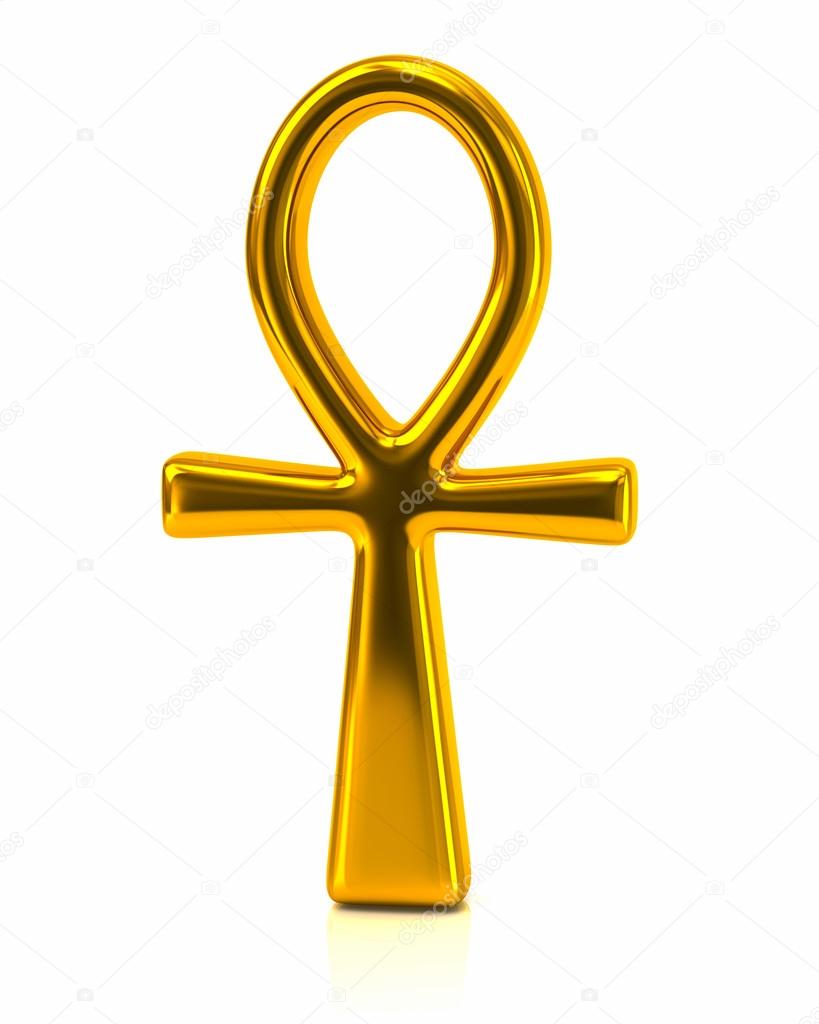
The looped cross is the Egyptian symbol for life — and not by association. The ankh is the hieroglyph that spells the word "life", so when a god holds one to a pharaoh's nose in a temple relief, the picture is a sentence: life is being given.
It is the most recognisable Egyptian symbol in the world and the one most often worn today. Our full guide explains why the Egyptians called it the key of life, where the shape came from, and how to say it.
The Eye of Horus: Healing and Protection

Called the wedjat, "the one that is whole", this is the left eye of Horus — torn out by Set and restored again. It stands for healing, protection and anything broken being made well. It is the commonest amulet to survive from ancient Egypt, and embalmers laid one over the incision in the mummy's side.
The full story sits in our guide to the Eye of Horus and the myth behind it.
The Eye of Ra: the Sun's Weapon
Similar in shape, close to opposite in meaning. The Eye of Ra is the right eye, tied to the sun, and it is a force Ra sends out to punish — appearing as Sekhmet, Hathor, Bastet or Wadjet. It is not a blessing; it is a lion let loose.
Wearing one when you meant the other is easy. We set them side by side in our comparison of the two eyes.
The Scarab: Rebirth and the Rising Sun

Egyptians watched the dung beetle roll a ball of dung across the ground and saw the sun being pushed across the sky. Because young beetles seemed to emerge from the ball itself, the scarab became the sign of self-creation and rebirth, linked to the dawn god Khepri.
Scarabs survive in huge numbers, often inscribed on the flat underside with a name or a motto. A special class, the heart scarab, was placed over the mummy's heart carrying a spell instructing it not to testify against its owner at judgement.
The Djed Pillar: Stability

A column with four horizontal bars near the top, usually read as the backbone of Osiris. It means stability and endurance, and it is one of the three signs that appear together as a set: ankh (life), djed (stability), was (dominion) — the full package granted to a king.
The "raising of the djed" was a real ceremony, in which the pillar was hauled upright to re-enact Osiris rising. It is carved along temple friezes throughout Upper Egypt.
The Was Sceptre: Power and Dominion
A long staff with a forked base and a stylised animal head at the top — probably the Set animal. Gods hold it in one hand while holding the ankh in the other, which is the standard divine pose you will see hundreds of times on a single temple wall once you know it.
The Lotus: Rebirth and the First Morning

The blue lotus closes at night, sinks, and opens again at dawn — so Egyptians made it the flower of rebirth and of the sun's first rising. In one creation account the sun god emerges from a lotus on the primeval waters.
It is everywhere in Egyptian design: as column capitals, in the hands of banqueters at parties, and paired with the papyrus, which stood for Lower Egypt while the lotus stood for Upper Egypt. The two knotted together is the sign for a unified country.
The Feather of Maat: Truth and Balance
A single ostrich feather, and the most consequential symbol in Egyptian religion. At judgement the dead person's heart was weighed against it. Balance meant passage to the afterlife; a heart heavier than the feather was eaten by Ammit and the person ceased to exist.
Maat was not only truth but the correct order of the universe, and maintaining it was formally the pharaoh's job.
The Cartouche: a Name Protected
The oval loop drawn around royal names is a rope tied at one end, and it means "everything the sun encircles" — a claim to rule all of it. It also protected the name inside, which mattered, because Egyptians held that a person survived only while their name did.
That is why the names of disgraced rulers were chiselled out: erasing the name erased the person. It is also why a cartouche pendant with your own name in hieroglyphs is the one souvenir with genuine Egyptian logic behind it.
The Shen Ring: Eternity
A circle of rope with the ends bound, having no beginning and no end — eternity, and protection by encirclement. Stretch a shen ring into an oval and you have the cartouche. Falcons and vultures are shown gripping one in their claws above the king.
The Winged Sun Disc
A sun disc flanked by outstretched falcon wings and usually two cobras, carved above temple doorways throughout Egypt. It represents Horus of Edfu and functions as protection over the threshold. If you photograph one temple entrance in Egypt, this is what will be at the top of the frame.
The Uraeus: the Cobra at the Brow
The rearing cobra on the front of the royal headdress is Wadjet, spitting fire at the king's enemies. It is a compact statement of legitimacy: the goddess herself is on your forehead. Tutankhamun's gold mask carries the cobra beside the vulture of Nekhbet, the two together standing for a unified Upper and Lower Egypt.
Egyptian Symbols of Protection
Protection was the single most common job an Egyptian symbol did. The wedjat, the shen ring, the uraeus, the sa sign and Bes the household god all guarded against illness, snakes, scorpions and misfortune in the afterlife. We catalogue the full set in our guide to the amulets Egyptians wore against harm.
Egyptian Symbols of Death and the Afterlife
Egypt has no symbol that means "death" the way a skull does in Europe — because death was a transition, not an ending. The signs that cluster around it are about continuation: the ankh for ongoing life, the djed for the resurrected Osiris, the scarab for rebirth, the feather of Maat for judgement.
The closest thing to a death symbol is Anubis, the jackal-headed god of embalming, who presides over the process rather than causing it.
Egyptian Symbols of Love and Fertility
There is no single Egyptian "symbol for love", and any jewellery sold as one is a modern invention. What Egypt had instead were deities and signs associated with love, beauty and fertility: Hathor, goddess of love and music, shown as a cow or a woman with cow's horns holding a sun disc; the sistrum, the rattle shaken in her worship; the lotus, tied to renewal; and Taweret, the hippopotamus goddess who protected women in childbirth.
Love poetry survives from the New Kingdom and is startlingly direct, but it uses ordinary imagery — birds, gardens, the river — rather than a dedicated symbol.
Symbols of the Egyptian Gods
Most Egyptian gods are identified by an object balanced on the head rather than by facial features. Isis wears a throne, Nephthys a house-and-basket, Hathor the horns and disc, Thoth appears as an ibis, Anubis as a jackal, Sobek as a crocodile. Read the headgear and you can name almost anyone on a temple wall.
The complete roster, with the symbol each deity carries, is in our list of the gods of Egypt.
Egyptian Symbols in Tattoos
The ankh, the Eye of Horus and the scarab are among the most-tattooed symbols in the world, and they suit the medium because they were designed as clean outlines to be cut in stone.
Two things worth getting right. First, pick the correct eye — the healing one and the punishing one look alike. Second, work from a photograph of a real relief rather than a flash sheet; mass-market versions round off the falcon markings on the wedjat and widen the ankh's loop into a circle, and both changes make the symbol read as generic.
Where to See These Symbols in Egypt
All of them are still in place, and most are within reach on a normal itinerary:
- Karnak, Luxor — the greatest concentration anywhere. Ankhs, djed pillars and was sceptres on nearly every column of the Hypostyle Hall.
- Luxor Temple — the birth-room reliefs, and Coptic crosses carved beside pharaonic signs.
- The Valley of the Kings — painted rather than carved, with the colour intact.
- Edfu — the best-preserved temple in Egypt, and Horus's own house.
- Abydos — the finest low relief in the country.
- The Egyptian Museum, Cairo — the amulets, and Tutankhamun's burial goods.
Edfu sits on the river between Luxor and Aswan, which is why every Nile cruise stops there. A 4-day Nile cruise covers Edfu, Kom Ombo and Luxor's temples together; a day tour will get you to the museum if Cairo is your only stop.
Go Deeper on Each Symbol
Full guides:
- The Ankh: meaning, origin and the key of life
- Ankh Meaning: what the key of life represents
- The Egyptian Ankh in Art and Jewellery
- The Eye of Horus and the wedjat myth
- The Eye of Ra
- Eye of Ra vs Eye of Horus
- Egyptian Protection Symbols
- Free Hieroglyphics Translator
What is the Egyptian symbol of life?
The ankh — the looped cross. It is the hieroglyph that spells the Egyptian word for "life", so it does not merely represent life, it writes it. Gods are shown holding it to the nose of a pharaoh, which depicts life being granted.
What do Egyptian symbols mean?
Most carry a fixed, readable meaning because they are hieroglyphs as well as symbols: ankh for life, djed for stability, was for dominion, wedjat for healing, scarab for rebirth, the feather of Maat for truth. They were used to make something happen, not to decorate.
What is the most important Egyptian symbol?
The ankh is the most recognised and most widely used. By religious weight the feather of Maat arguably outranks it, since the entire afterlife turned on the heart balancing against it.
What is the Egyptian symbol for protection?
The Eye of Horus is the best known, but Egyptians used several: the shen ring, the uraeus cobra, the sa sign, and the god Bes for the household. Protection was the commonest function of Egyptian amulets by a wide margin.
Is there an Egyptian symbol for love?
Not a single dedicated one. Love and fertility were expressed through deities and objects — Hathor, the sistrum, the lotus, Taweret for childbirth. Anything sold as "the Egyptian symbol for love" is a modern invention.
What is the Egyptian symbol of death?
Egypt had no equivalent of the skull, because death was treated as a transition. The related symbols are about continuation instead: the ankh, the djed, the scarab and the feather of Maat. Anubis, the jackal-headed god, presides over embalming.
Are Egyptian symbols and hieroglyphics the same thing?
Overlapping but not identical. Hieroglyphics are the writing system, roughly a thousand signs. Many famous symbols are hieroglyphs that also worked as standalone objects and amulets, but a symbol like the winged sun disc is architectural imagery rather than a letter in a word.
What is the oldest Egyptian symbol?
Among the oldest still recognised are the ankh, the djed and the was sceptre, all fully formed by the Early Dynastic Period around 3000 BCE — before the pyramids at Giza were built. Their origins predate the written records that might have explained them.
See Them Where They Were Carved
We are an Egyptian company running small-group and private trips to the temples where these symbols were cut, with licensed Egyptologist guides who can read the walls to you.
Plan a private tour → · Nile cruise itineraries · Cairo and Luxor in three nights
Planning your Egypt trip?
Tell us your dates and what you want to see. Our local team replies within 24 hours with a tailor-made plan and a clear price.
Get your free consultation